
Home / Services / Commercial Soil pH Testing Vancouver
Vancouver, British Columbia
Commercial Soil pH Testing Services Vancouver
Your crew fertilizes on schedule. The lawn still looks tired or patchy. That's usually not a fertilizer problem — most turf trouble starts underground, not on the surface. If nutrients can't reach the roots, no amount of feeding fixes it. That's the gap we close.
Field meter or lab-verified
Multi-zone sampling
Licensed technicians
Documented results
10+
Years of combined team experience
6–7
The pH range commercial turf wants
2
Methods — field meter and lab analysis
Multi
Zone sampling, not one reading per site
The number
Why soil pH testing matters for commercial lawns
Soil pH is a number that tells you how the ground beneath your turf behaves. A property manager doesn't need a chemistry background to use it — just someone to read it and act on it.
Turf target · 6.0–7.0
4
5
6
7
8
9
Acidic · below 7
Above 7 · alkaline

Vancouver soil drifts acidic. Heavy rain washes calcium and other alkaline minerals out of the ground over time, and conifer needles near mature trees add to it — so soil moves further acidic year after year. A testing visit here often turns up a surprising number.

Find out what's happening below the surface
One reading changes what you apply next.
Our process
Our commercial soil testing process
We build testing around two methods, used together or separately depending on the property.

On site
Calibrated field meter
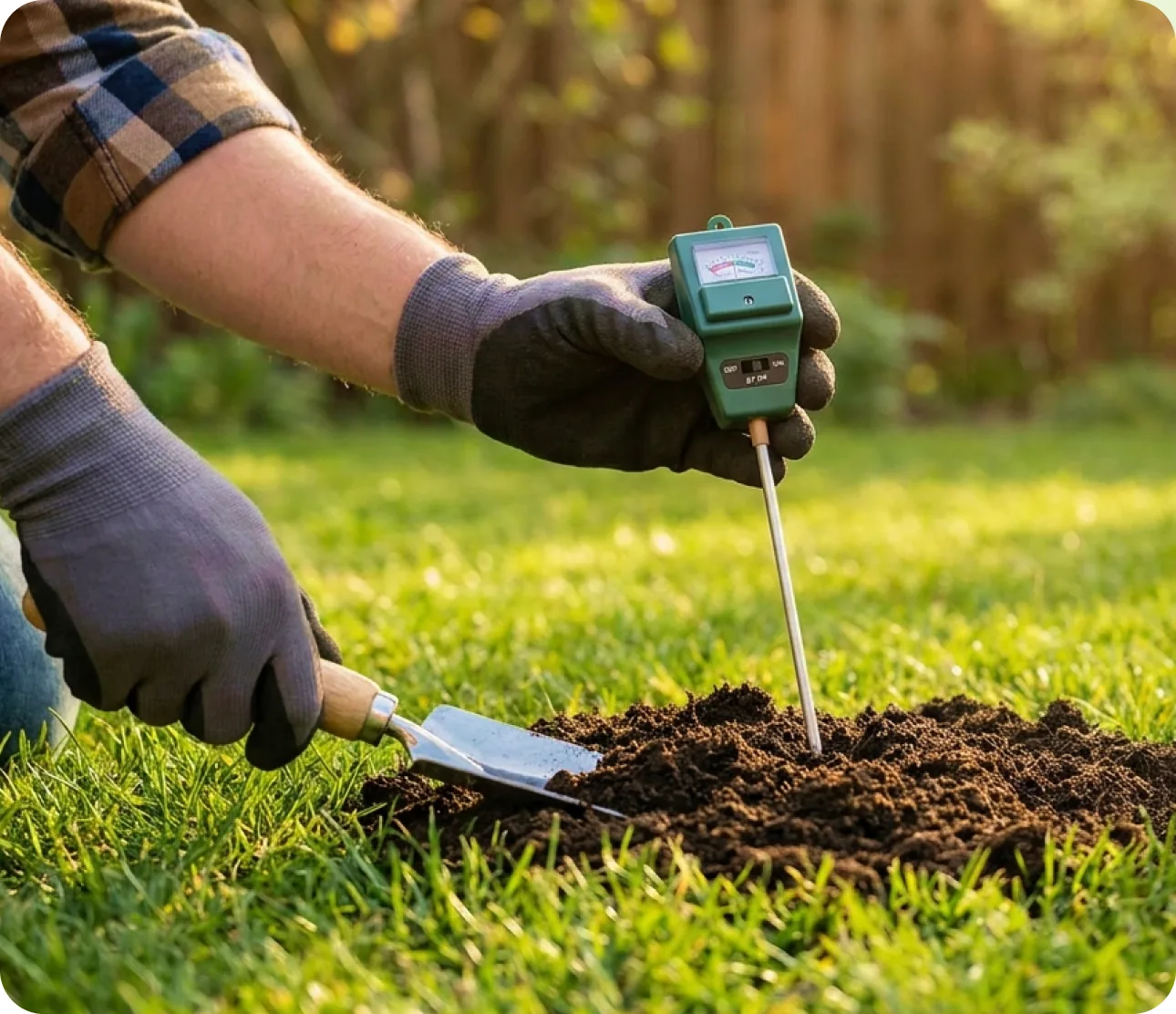
A quick on-site reading gives an immediate sense of where a lawn stands. For simple properties, that's often enough to act on.
Immediate result · lower cost

Lab
Lab-verified sample
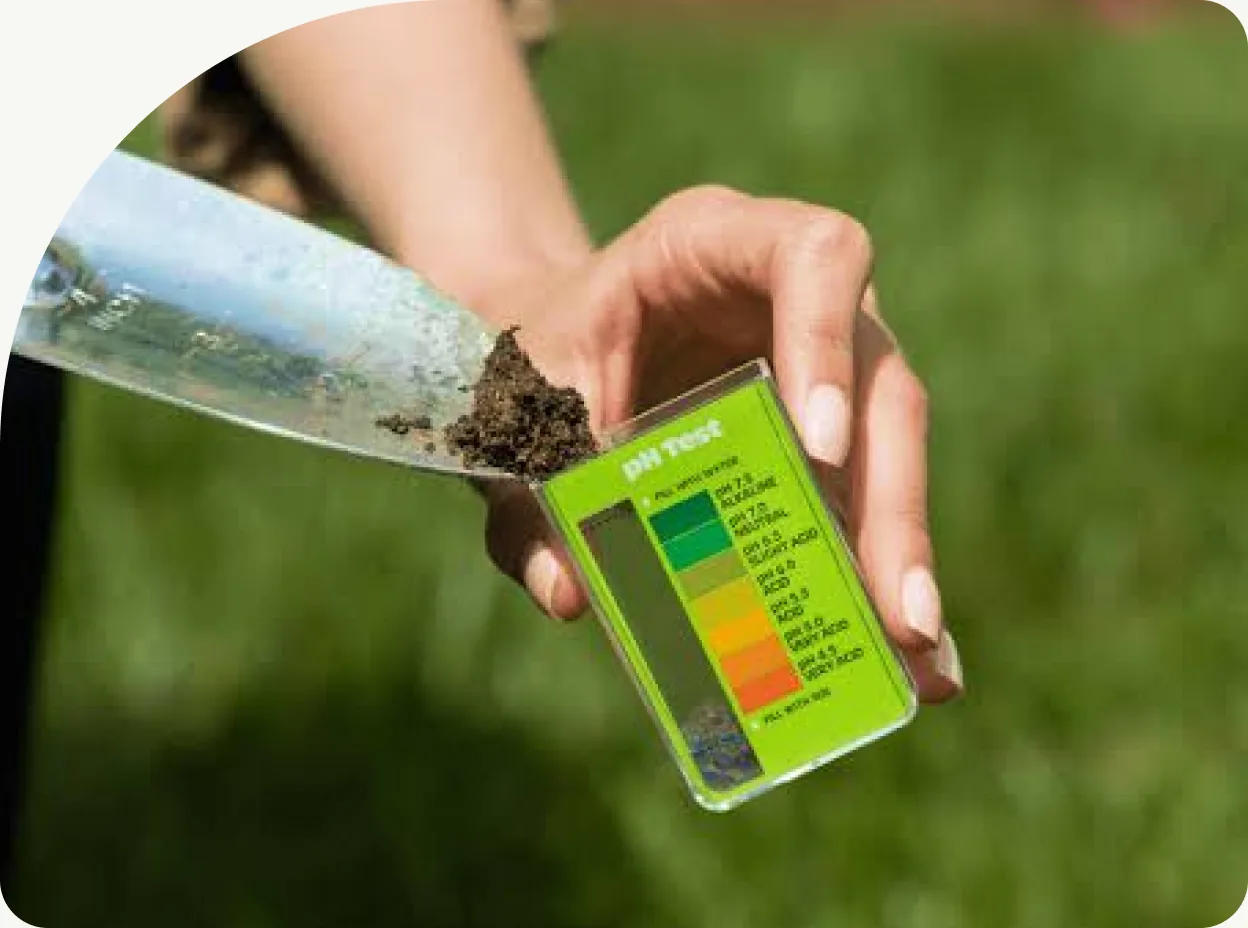
For anything more complex we pull a soil sample and send it to a lab for verified results — and if readings come back inconsistent, or a manager needs documentation for a budget request, we go this route instead.
Verified · documented for budget requests

Multi-zone soil sampling
Strata buildings, office parks, and mixed-use sites rarely have one uniform lawn — shade on one side, sun on another, different soil brought in at different times. We pull readings from multiple points instead of assuming one number fits the whole property.

When lab testing is recommended
Inconsistent field readings are one trigger. The other is paperwork: if you need a documented result to support a budget request, the lab sample is what gives you something to put in front of a council.

Build a smarter fertilization plan
Readings first, then the program.
The payoff
Healthy grass starts with the right soil
Fixing the number underground shows up in ways property managers and business owners actually notice above ground.

Nutrient uptake restored
Once pH sits right, the nitrogen, phosphorus, and potassium already applied finally reach the roots instead of sitting locked in the ground.

Better fertilizer efficiency
Every dollar spent on fertilizer after correction actually does something, instead of feeding soil that was blocking it from the start.

Reduced moss and weed pressure
Moss and several common weeds thrive in acidic conditions. Correcting pH removes the environment they depend on, instead of treating the symptom over and over.

Stronger root development
Healthy soil lets roots grow deeper and wider, which is what keeps turf standing up to foot traffic and winter stress.

Healthier, more even turf
A corrected pH shows up visually — thicker coverage, more uniform green, fewer patchy or bare sections across the property as a whole.

Long-term soil health
Soil chemistry drifts again over time, especially in a rainy climate. Treating testing as an ongoing part of a landscape budget, not a single expense, keeps a property from sliding back to square one.

Get a custom testing plan
Built around your zones, not a single reading.
The mechanism
How soil pH affects nutrient availability
Nutrients don't vanish from acidic or alkaline soil. They become chemically stuck — present but unavailable to the plant. That single fact sits behind more lawn complaints than anything else we see.
N
P
K
Outside 6.0–7.0
Present but locked out
Outside the right range, nitrogen, phosphorus and potassium bind to soil particles that roots can't absorb. Double the fertilizer, see zero improvement — the amount was never the problem.
Applied, paid for, unavailable
N
P
K
Within 6.0–7.0
Usable again
Around 6.0 to 7.0, most of what turf needs becomes usable again. This is the target range we work toward on every commercial visit, and the number every amendment plan is built around.
Same fertilizer, real result

Schedule a professional soil test
Stop paying for nutrients the soil is blocking.
What happens next
From soil test results to a custom amendment plan
A number alone fixes nothing. The value is in what happens next — turning a reading into an amendment plan built for the property.

If acidic — the usual case here
Lime raises pH
Lime brings the number back up toward a workable range over time. This is the core of pH correction on most Vancouver commercial turf.

If alkaline
Sulphur lowers pH
Rarer in this region, but it does happen. Sulphur brings the number back down instead.
Less common locally

Neither is a one-time miracle. Both work gradually, over weeks and months, as soil chemistry shifts.

Amendments based on your results
We don't run one blanket lime application across every property. The amendment depends on how far off the reading sits, the turf type, and the site's history. Generic programs treat every lawn the same — proper testing and amendment don't.

Adjusting fertilizer after correction
As lime or sulphur takes effect, soil keeps shifting for weeks afterward. We check in and adjust the fertilization approach, instead of applying the same plan regardless of what the sample shows.

Talk with a commercial turf specialist
A reading, then a plan built around it.
Program fit
How soil testing improves your fertilization program
Testing isn't a separate line item sitting apart from everything else we do on a property. Results shape the fertilization program itself — what gets applied, how much, and when.
Without a current reading, a fertilization schedule is a best guess. With one, it's a plan built on the property's actual chemistry. That difference tends to show within a season or two, once locked-out nutrients reach the turf again.
01
Without a reading
The schedule is a best guess, however well-intentioned.
02
With a reading
A plan built on the property's actual chemistry.
03
One to two seasons
Where the difference typically becomes visible above ground.

Book a soil pH test
Then let the results set the schedule.
Pricing
What to consider when budgeting for soil testing
Every property is different, so cost gets calculated around a handful of factors rather than one flat number. Pricing depends on the property itself — ask us directly and skip the guesswork.

Property size
Larger properties need more sampling points and time on site — usually the first thing we confirm.

Number of sample zones
A single, uniform lawn needs fewer sample points than a multi-zone property with different soil conditions or drainage.

Field testing vs lab analysis
A quick field reading costs less than a full lab-verified sample. Which tier makes sense changes the final number.

Testing frequency
A single test answers a single question. An ongoing schedule works out more efficiently than starting fresh each year, and keeps cost predictable.

Bundling with lawn care
Properties already running a fertilization program with us often see testing and amendment folded into that agreement rather than priced separately.
Request a custom pricing estimate
Tell us the property and we'll confirm size, zones and which testing tier fits.
Why Weed Bros
Qualified service backed by professional standards
With over 10 years of combined team experience, we bring the technical background and paperwork commercial clients need before signing off.

Licensed technicians
Our technicians work under proper licensing, so lime, sulphur, or other treatments go down correctly. That's the standard behind our commercial soil testing work.

Liability coverage on file
We carry the liability coverage strata councils and facility managers expect from any contractor on shared grounds — part of why we're trusted across Vancouver's commercial market.

Minimal disruption to operations
Commercial sites don't stop running while lawn work happens. Our crews schedule around business hours, so a sample gets collected without disrupting daily operations — which suits tenant-occupied buildings.

Build a better turf plan
Licensing and coverage on file before we start.
FAQ
Frequently asked questions
What property managers ask most about soil testing and amendment.
01Can we just use a DIY soil pH kit instead of hiring a professional?
A store-bought meter gives a rough sense of acidity, but it won't match professional testing, and it won't tell you what to do with the number. Professional testing also documents results.
02Is it safe for staff, tenants, or pets on the grass right after a lime or sulphur application?
Generally yes, once the product has been watered in. Our technicians confirm the timing so building management can plan around it.
03How long after treatment will we actually see a difference?
Lime and sulphur both work gradually. Most properties notice a shift within weeks, though the full change can take a few months.
04What's the best time of year to schedule this for a commercial property?
Spring and fall both work well, since amendments react before the growing season peaks or winter sets in. That said, a soil sample can be pulled any time.
Next step
Schedule commercial soil pH testing today
If your turf keeps looking weak, patchy, or slow to improve, the problem may not be the fertilizer at all — and that kind of guesswork gets costly fast. A soil pH test gives you a real number, so you're not just feeding the lawn and hoping.
We can check what's going on below the surface and give you a clear next step, whether that means a one-time test or a plan for ongoing care.
Get Started Today
1-833-WEED-PRO
Mon–Fri 7am–6pm

hello@weedbros.ca
Estimates by email

Vancouver & Lower Mainland
Strata, office & mixed-use grounds